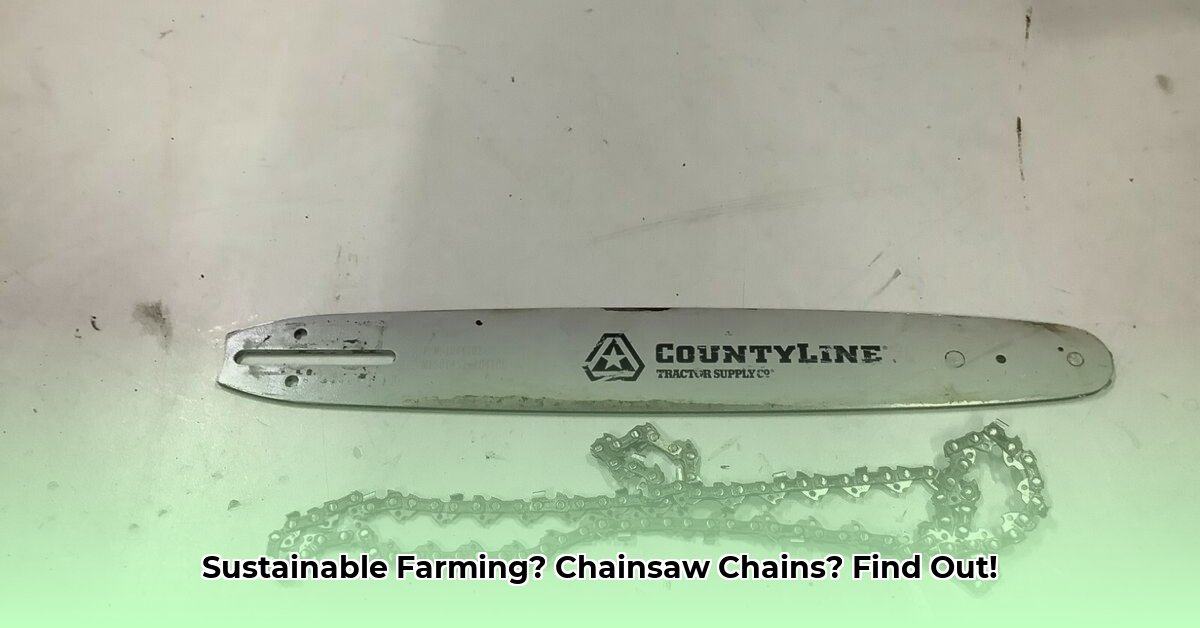
Maintaining your chainsaw is crucial for efficient and sustainable farming. This guide will walk you through selecting, using, and maintaining Tractor Supply chainsaw chains, helping you maximize efficiency and minimize environmental impact. We’ll cover chain selection, sharpening, lubrication, safety, and sustainable practices, ensuring you get the most out of your equipment while protecting the environment. For more on sustainable farming practices, check out this helpful guide on chicken tractors.
Picking the Right Chain for the Job
Choosing the correct chain is paramount for efficient and safe operation. Tractor Supply offers a variety of chains, each designed for specific tasks and wood types. Improper selection can lead to decreased efficiency, increased fuel consumption, and even safety hazards.
Key Factors to Consider:
- Gauge: This refers to the thickness of the chain (e.g., .050", .058", .063"). Thinner gauges are faster-cutting but less durable; thicker ones are more durable but cut slower. Consider using a thinner gauge (.050") for hardwoods and a thicker gauge (.063") for softwoods.
- Pitch: This is the distance between drive links (e.g., 3/8", 3/8" LP, .404"). It determines chain speed and cutting power. Match the pitch to your chainsaw's specifications. Larger pitches (e.g., .404") are best for larger engines and felling large trees, whereas smaller pitches (e.g., 3/8") are suit smaller engines and finer cuts.
- Cutter Type: Chisel cutters are aggressive for hardwoods, but require more frequent sharpening. Semi-skip teeth offer a balance between cutting speed and durability, while full-skip teeth are ideal for faster cutting in softer woods, but may be less durable for hardwoods.
Selecting the Right Chain for Specific Tasks:
| Task | Recommended Gauge | Recommended Pitch | Cutter Type |
|---|---|---|---|
| Felling large trees | .050" | 3/8" LP or .404" | Chisel |
| Pruning small branches | .058" | 3/8" | Semi-skip |
| Cutting firewood | .058" or .063" | 3/8" | Semi-skip or Full Skip |
Don't forget to always check the Tractor Supply website or packaging for specific recommendations.
Sharpening Your Chain: A Step-by-Step Guide
A sharp chain is crucial for safety and efficiency. A dull chain requires more force, increases the risk of kickback, and damages both the chain and the bar.
Step-by-Step Sharpening Instructions:
- Safety First: Wear safety glasses, gloves, and hearing protection. Securely clamp the bar in a vise.
- File Selection: Use a round file that matches your chain's gauge and angle (typically a 5/32" or 7/32" file).
- Filing Technique: File each cutter tooth individually, maintaining consistent pressure and angle (usually 30 degrees).
- Depth Gauge: Use a depth gauge to ensure all cutters are the same length for a smooth, even cut.
- Cleaning: Remove metal filings before using the chainsaw.
Remember, regular sharpening—after a few hours of use—significantly improves performance and safety.
Maintaining Your Chainsaw Chain for Longevity
Proper lubrication and tension are essential for extending chain life and ensuring smooth operation.
- Lubrication: Use a biodegradable bar and chain oil for environmental responsibility. Regularly check oil levels.
- Tension: Ensure proper chain tension—a loose chain increases the risk of derailment and damage. Consult your chainsaw's manual for proper tensioning techniques.
Sustainable Practices with Tractor Supply Chainsaw Chains
Sustainable farming involves minimizing environmental impact. Efficient chainsaw use contributes significantly.
- Fuel Efficiency: A sharp chain requires less power, reducing fuel consumption and emissions.
- Wood Waste Reduction: Precise cuts minimize wood waste, promoting efficient resource utilization.
- Chain Recycling: Explore recycling options for worn-out chains to reduce landfill waste. Recycling programs are sometimes offered by retailers like Tractor Supply.
Troubleshooting Common Issues
Problem: Sluggish cutting or stalling. Possible Cause: Dull chain, incorrect chain tension.
Problem: Chain binding. Possible Cause: Obstructions or damage.
Problem: Kickback. Possible Cause: Using an improperly maintained chain, unsafe techniques.
Consult your chainsaw's manual for detailed troubleshooting. Preventative maintenance is crucial for avoiding costly repairs and ensuring safe operation.
Key Takeaways:
- Choosing the right chain for the task maximizes efficiency and reduces waste.
- Regular sharpening and lubrication greatly extend chain life, saving money and resources.
- Safe operation and sustainable practices minimize environmental impact.
Remember, responsible chainsaw use is key to efficient and sustainable farming. By following this guide, you can optimize your Tractor Supply chainsaw chains for years of reliable service while minimizing your environmental footprint.
Tractor Supply Chainsaw Chains
Content about tractor supply chainsaw chains (Auto-generated fallback due to API error).
Tractor Supply Chainsaw Chains
Content about tractor supply chainsaw chains (Auto-generated fallback due to API error).